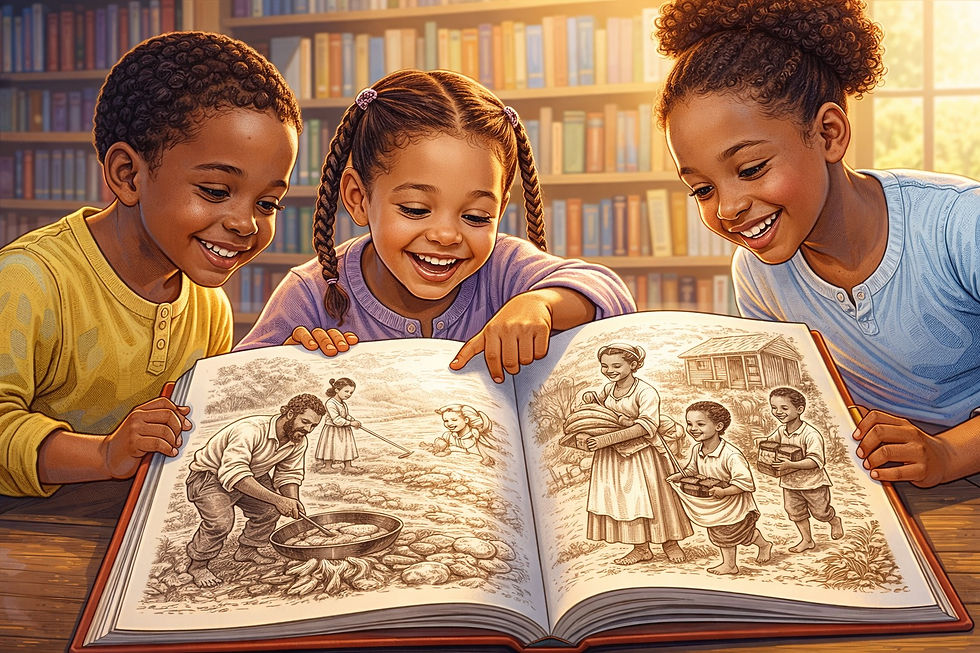
A Note to Readers & Families

Updated: Feb 4
Welcome to a 365-day journey of American Black History.
This collection, produced by Caterpillar Curriculum Co., is designed to spark meaningful discussion, encourage curiosity, and invite deeper exploration for learners in grades 3–12—throughout the year and especially during Black History Month.

Rather than rushing through history, these workbooks are intentionally structured so that one or two pages may be explored each day. Families and educators are encouraged to pause, ask questions, reflect together, and—when appropriate—seek additional sources to expand understanding.
Children deserve history that tells the truth without stripping away dignity, hope, or imagination.
This collection includes both documented historical facts and oral histories passed down through generations, honoring the many ways knowledge has been preserved and shared over time. Together, they help illuminate how the past continues to shape the America we live in today.
When confronted with a historical experience or record that is difficult to learn or discuss, pause and say: “This is a part of History. I don’t have to carry the weight of these facts. But I can study them and learn from them.”
What We Mean by “Black History”
In this collection, American Black History refers to the lived experiences, achievements, and contributions of enslaved Africans and their descendants in America.
The workbooks also address both past and present systems of racism, acknowledging obstacles Black Americans have faced while honoring their essential role in shaping the United States of America.
Today, people of African ancestry live on every continent. However, the word “Black” in the United States carries a very specific historical meaning—tied to slavery, racial classification, and the way American society was built and continues to function.
In Africa, people traditionally identify by ethnic group, not race. During chattel slavery, Africans were forcibly removed from their homelands, stripped of tribal identities, and grouped together under imposed racial labels such as “Negro,” and later, “Black.”
Over time, Black became a shared identity rooted in:
Survival
Culture
History
Resilience
Using References
Occasionally workbooks and blogs may reference additional websites. Please note:
These websites are not affiliated with, endorsed by, or sponsored by Caterpillar Curriculum Co.
Content on external sites may not be appropriate for all ages.
Guardians are encouraged to review websites in advance and determine what is suitable for their learners.
How This Collection Can Grow With You
Some families and classrooms will return to these workbooks year after year—going deeper each time as children mature.
For older students, the pages may serve as:
Research prompts
Story starters
Museum or library exploration guides
A foundation for broader historical themes and discussions
This flexibility allows the material to grow alongside the learner.
American Black History Is American History
In the United States, “Black History” is often taught as a separate or segmented part of American History. In reality, American Black History is woven throughout the entire American experience—from before the founding of the United States to the present day.
Studying American Black History opens the door to understanding:
The full scope of American History
The struggles and triumphs that shaped the nation
The roots of systemic injustice
The voices and contributions too often left out of mainstream education
Why Acknowledging History Matters
When any part of history—whether triumph, failure, or trauma—is ignored, the result is a distorted picture. Denial often leads to repeating the same mistakes.
Acknowledging history does not mean assigning guilt.
We inherit stories, not guilt. Our ancestors made choices—some heroic, some harmful. We do not carry their guilt, but we do live with the impact of those choices.
Acknowledgement is not shame.
Acknowledgement is understanding.
When suffering is recognized, healing can begin. When the past is faced honestly, we become free to make new and conscious choices, rather than repeating unseen patterns.
Lastly, we are pleased to include two special sections:, original historical fiction stories inspired by research and recipes from specific centuries.
Roots & Wings Historical Fiction
Throughout the workbooks, you will find pages labeled “Roots & Wings Historical Fiction.” These stories are fictional, but they are carefully inspired by real historical contexts and experiences. The purpose is not to replace history, but to help learners form a healthy emotional connection to complex or difficult subjects—supporting empathy, imagination, and reflection alongside factual learning.
Soul Food Sundays
At the end of each collection, readers will find a small bonus section drawn from “52 Weeks of Soul Food Sunday Recipes.” These recipes honor food as history—carrying memory, culture, and resilience across generations—and offer families another meaningful way to connect with the past together.
Closing Thought
Our hope is that this collection helps learners grow with:
Strong roots in truth and understanding
Strong wings of empathy, curiosity, and wisdom
Thank you for choosing to walk this journey with care.