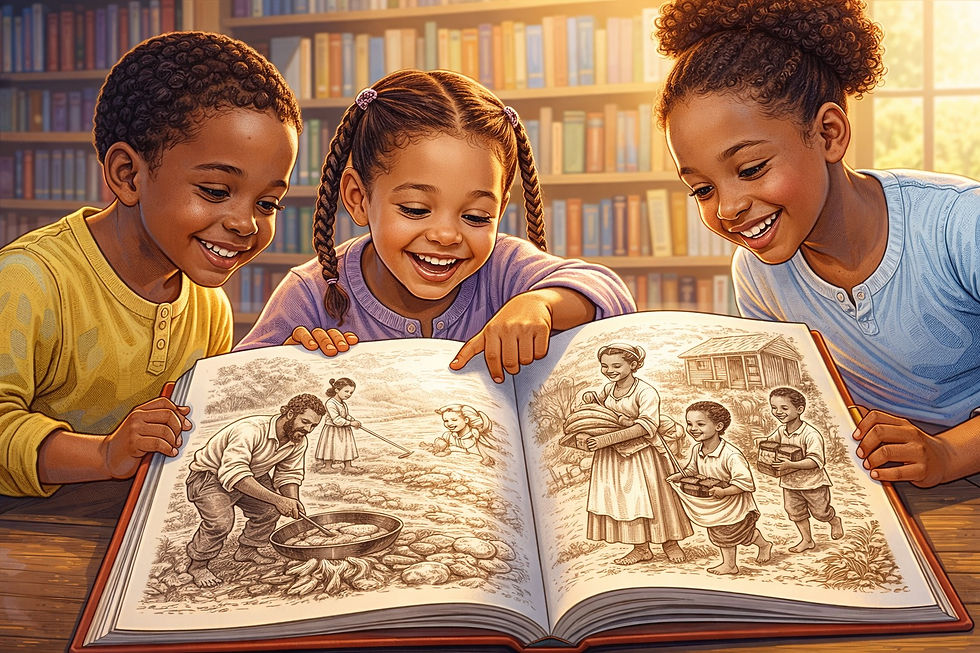
More Complete History

Updated: Dec 28, 2025

We recognize that the term “Honest History” can feel controversial—not because facts don’t exist, but because humans decide which facts are taught, emphasized, minimized, or ignored. Power, access to education, literacy, safety, and social status have always shaped whose stories were written down and preserved, and whose were dismissed or erased.
Historians widely agree that History is not static. It evolves as new evidence is uncovered, as voices long excluded are finally included, and as scholars re-examine earlier conclusions through a more honest and complete lens. This process is not about rewriting History to make people uncomfortable; it is about correcting incomplete narratives.
As author Gloria Jean Watkins, better known by her pen name bell hooks reminds us: “The function of education is to teach one to think intensively and to think critically. Intelligence plus character—that is the goal of true education.”
That principle matters deeply when we think about how children encounter History.
A more complete History builds strong wings because children already experience the full range of the human story—love and hate, fairness and injustice, kindness and cruelty, success and failure, wisdom and shame. These are not adult concepts; they are human ones.
When History reflects a more. complete human experience—good and bad, beautiful and painful—it gives children language for what they already feel and observe. It helps them understand that struggle is not a personal failure, and that goodness can exist alongside hardship. A more complete History teaches that people are complex, systems are imperfect, and progress is rarely simple.
Seeing humanity for what it is—across time, cultures, and communities—allows children to carry their roots with confidence. They learn where they come from, what their people endured, and how creativity, resilience, and love can persist even in difficult circumstances. At the same time, a more complete History grows wings with humility. It reminds us that no one group has a monopoly on goodness or wrongdoing, and that learning from the past requires both courage and compassion.
At Caterpillar Curriculum, we don’t claim to be curating “the truth.” Instead, our goal is to model how to seek and teach recorded and oral Histories responsibly—by using credible sources, acknowledging complexity, honoring lived experience alongside documented records AND by teaching these things in age-appropriate and creative ways.
Teaching this way is an act of respect: for children’s intelligence, for the people who came before us, and for the kind of humans we hope our children will become.