Age-Appropriate American Black History Is Vital

Updated: Jan 11
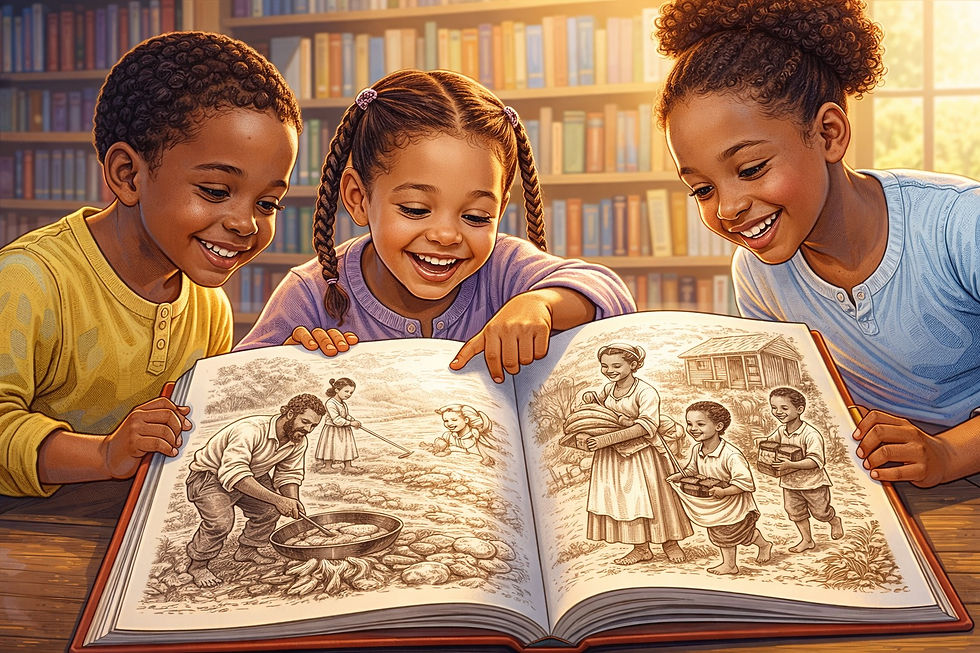
We believe children deserve thoughtful (curated) History that does not avoid difficult topics, but intentionally teaches children without dwelling on violence or presenting trauma as the central story. We focus on culture, daily life, creativity, resistance, and resilience alongside historical realities.

Much of the American Black History content available today—books, documentaries, films, and even classroom resources—were created for adults. These materials often include:
Graphic depictions of violence
Sexual exploitation and assault
Harsh or explicit language
Highly polarized framing
Emotional intensity that assumes adult processing skills
These realities are part of History. They should not be erased. But they are not developmentally appropriate as a starting point for children.
Children do not need graphic detail to understand that people were enslaved, families were separated, freedom was denied, and resistance existed.
Truth is conveyed through meaning, not shock. These truths can be taught using clear age-appropriate language, thoughtful storytelling, timelines and human experiences that children can grasp.
Children Deserve Truth With Care
Young children do not yet have the cognitive or emotional tools to process extreme cruelty, sexual violence, or relentless brutality. When they are exposed too early—or without adequate support—history can become:
Confusing instead of clarifying
Frightening instead of empowering
Alienating instead of affirming
As Joy DeGruy explains in Post Traumatic Slave Syndrome, unprocessed historical trauma does not simply disappear—it is transmitted: “If trauma is not transformed, it will be transferred.”
That insight matters deeply in education.
Age-appropriate American Black History does not mean “watered down.”
It means carefully framed. It means choosing language, visuals, and narratives that:
Tell the truth without sensationalism
Emphasize humanity alongside hardship
Center people—not just pain
Allow space for curiosity, pride, and connection
There is a quiet assumption in education that if materials are respectful, gentle, and child-safe, they must also be boring.
This is simply untrue.
Children are deeply engaged by:
Stories
Characters
Everyday life
Mystery, problem-solving, and discovery
Visual beauty and symbolism
What often gets labeled as “boring” is not the absence of violence—it is the absence of imagination.
When American Black History is presented only as suffering or spectacle, children learn one narrow story.
When it is presented through families, work, creativity, resistance, community, and joy, children lean in.
Building Capacity, Not Avoidance
Age-appropriate American Black History is not about avoidance—it is about developmental readiness.
Children who first encounter American Black History through:
Gentle truth
Respectful visuals
Clear explanations
Human-centered storytelling
are better prepared—not less prepared—to later engage with complex, painful, and unjust realities.
They approach harder History with:
Context
Empathy
Emotional grounding
A sense of worth
This aligns with Dr. DeGruy’s broader work, which emphasizes that healing and understanding require timing, safety, and intentional care—especially for the next generation.
Our Responsibility as Educators and Caregivers
Children trust adults to guide them safely.
Providing age-appropriate American Black History is an act of responsibility, not censorship. It is a commitment to a more complete picture of History and childhood. History with care.
American Black History should not steal a child’s sense of safety.
It should expand their understanding of the world—and their place within it.